


A Street Is Not Dangerous by Accident
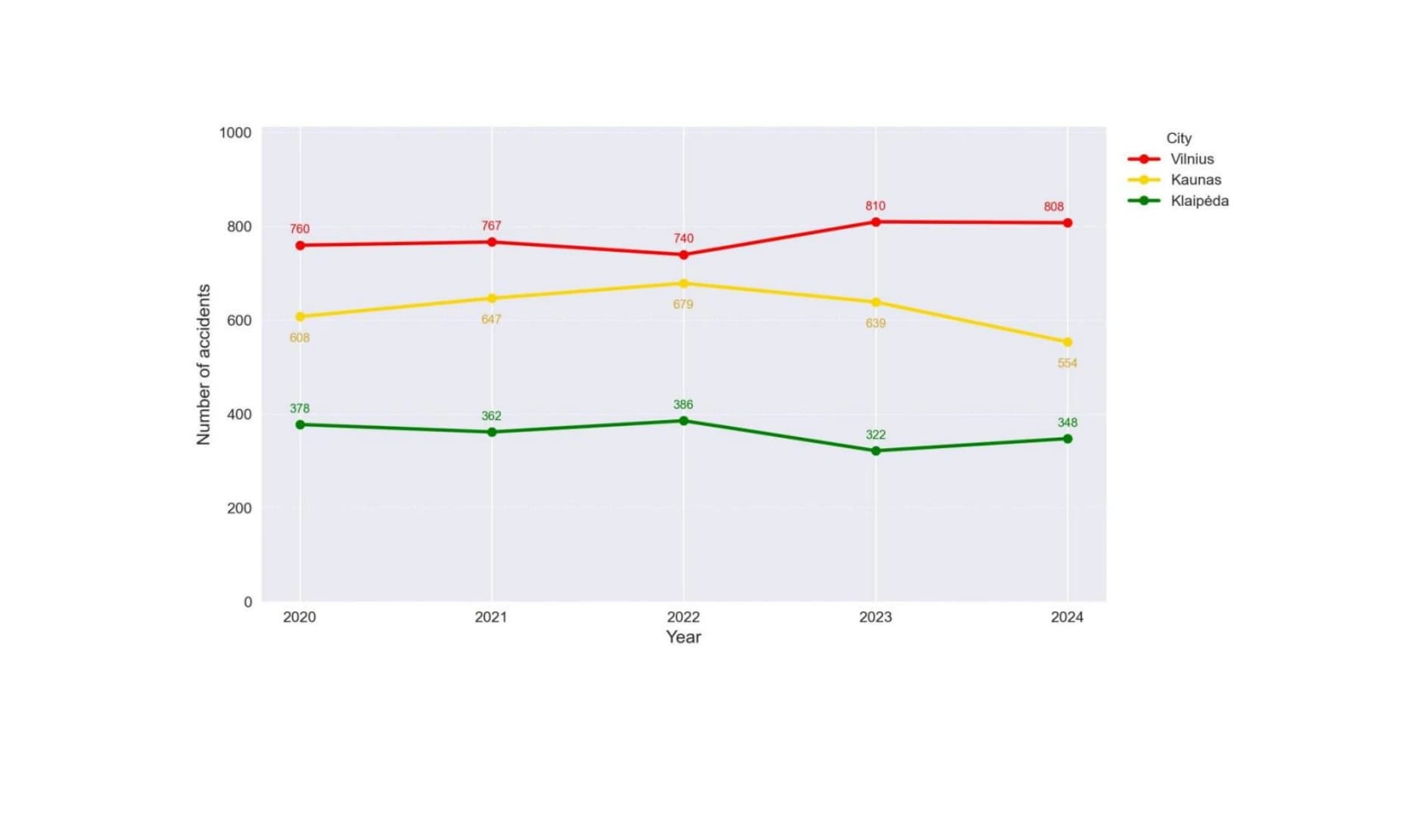
One of the strongest things I learned from accident data is this: dangerous roads are rarely just unlucky. When the same streets keep appearing again and again, the problem is usually structural, behavioral, or environmental — and often all three at once.
We talk about traffic accidents in a very human way.
Someone was distracted. Someone reacted too late. Someone was speeding. Someone made one bad decision.
All of that is true, but it is also incomplete.
Because once you start looking at accident data over multiple years, something uncomfortable becomes hard to ignore: some streets keep coming back.
Not occasionally. Consistently.
That was one of the most striking things I noticed while working on my thesis. In major Lithuanian cities, certain roads and corridors kept showing the same kind of risk concentration over time. At that point, it becomes difficult to call the pattern random.
Roads have personalities
That may sound dramatic, but I believe it more now than before.
A road is never just a road.
It is a combination of:
- visibility
- lane structure
- turning pressure
- pedestrian flow
- signage quality
- traffic density
- human impatience
- decision timing
When all of those things interact badly, the road starts behaving like a place that punishes normal mistakes more harshly than others.
And that matters.
Because it changes the question.
Instead of asking, “Why do people keep making mistakes here?” you start asking, “Why does this place keep making mistakes easier to make?”
The shift that changed my thinking
Accident analysis becomes much more useful when you stop treating crashes as isolated events and start treating them as repeated interactions between people and environments.
Human error is real, but the environment shapes it
Before this project, I probably leaned too much toward the usual explanation: people are careless.
Now I think the fuller answer is more interesting.
People are imperfect.
And some environments are much less forgiving of imperfection than others.
A distracted second on a calm, readable road may lead to nothing. The same distracted second on a crowded, confusing, multi-lane urban corridor may become a crash.
That does not remove responsibility from the driver.
It just reminds us that risk is not created by one thing alone.
Behavior matters
Distraction, overconfidence, delay, and poor judgment still play a huge role in road safety.
Context matters too
Intersections, dense flow, visibility issues, repeated lane changes, and pressure-heavy roads increase the chance that small mistakes become serious.
Patterns reveal what isolated stories hide
One accident may be anecdotal. Five years of recurring concentration on the same roads is not.
The part that stayed with me most
What really changed me was not just seeing the clusters.
It was realizing how normal they looked once I understood the surrounding conditions.
The streets were not “mysteriously dangerous.” They were often exactly the kind of places where cognitive load, movement complexity, and false confidence meet each other.
And that made the whole topic feel less abstract.
Risk was no longer just a number. It had shape. It had geography. It had repetition.
Quote
A dangerous street is usually not a surprise. It is a pattern that has already introduced itself many times.
What a reader can take from this
You do not need to work on traffic systems to learn something from this.
The broader lesson is that repeated failure is often environmental before it becomes personal.
In software, in cities, in interfaces, in organizations — if the same problem keeps appearing in the same place, the smartest response is not always “people should be better.”
Sometimes the smarter response is: what is it about this system that keeps making the same mistake likely?
That question is more useful. And usually more honest.
Final takeaway
I still believe human error matters.
But I no longer think it explains enough on its own.
Some roads keep creating the right conditions for bad outcomes. Some places stay risky because the system around the human is badly balanced. And once you see that clearly, road safety stops being only about blaming behavior.
It becomes about understanding patterns — and respecting what those patterns are trying to tell us.