


The Streets in Lithuania Where Accidents Never Stop Happening
TL;DR
Five years of official accident data from Lithuania tells a surprising story: the dangerous streets aren't random. The same corridors in Vilnius, Kaunas, and Klaipėda keep appearing, year after year. Here's what I found — and why it matters for everyone who drives here.
If I asked you to name the most dangerous street in your city, you probably couldn't. Most people can't. We drive through these streets every day without knowing.
I spent months working with five years of official accident data every recorded accident between 2020 and 2024. I cleaned it, mapped it, and analyzed it street by street.
What I found surprised me.
The accidents aren't random
Most people imagine traffic accidents as unpredictable events. Bad luck. Wrong place, wrong time.
The data says something different.
Quote
The same streets appear at the top of the list every single year. The problem isn't random — it's structural.
Three corridors show up again and again:
Savanorių prospektas, Kaunas
Over 100 recorded accidents in five years. Year after year, the same clusters form at the same intersections.
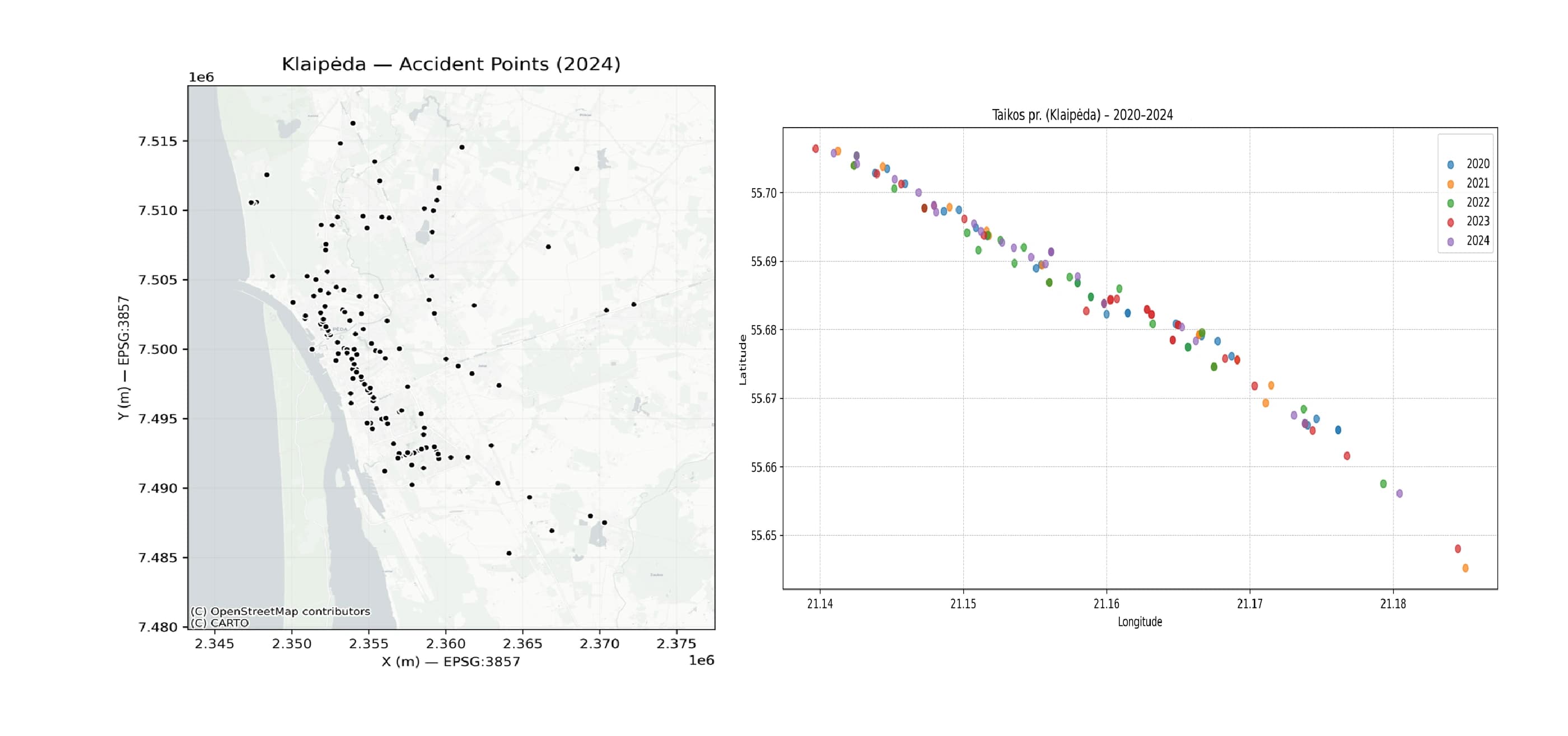
Taikos prospektas, Klaipėda
121 accidents. The most dangerous street in the entire city — consistently.
Laisvės prospektas, Vilnius
One of the densest accident corridors in the capital. Same hotspots every year.
These aren't just "busy streets." They're streets where the same pattern repeats so reliably that you could have predicted 2024's accidents from 2020's data.
The moment that caught me off guard
When I plotted five years of accidents on Savanorių prospektas, I expected a messy scatter of dots across the map.
Instead, I saw something unsettling: the dots stacked on top of each other. The 2020 accidents and the 2024 accidents were happening at almost the exact same coordinates.
The same intersections. The same corners. The same blind spots. Year after year.
What this really means
When accidents cluster on the same coordinates across multiple years, it's rarely "driver error." It usually means something about the road itself — the geometry, the sightlines, the signage — is quietly setting people up to fail.
When accidents peak
The data also revealed something most of us would never guess on our own.
Accidents don't peak at rush hour the way you'd expect. They peak between 16:00 and 18:00 — after the workday ends, when people are tired, distracted, and heading home.
And here's another counterintuitive finding: more accidents happen on clear, dry days than in snow or fog. When the weather looks dangerous, people drive carefully. When it looks safe, they stop paying attention.
This pattern even has a name in traffic research — risk compensation. The more dangerous the road feels, the safer people actually drive.
Why no one talks about this
Here's what bothered me most.
This data exists. It's official. It's public. And yet I've never heard anyone in Lithuania casually warn a friend: "Be careful on Taikos — it's the worst street in Klaipėda."
We know which restaurants are good. We know which neighborhoods are expensive. But we don't know which streets are statistically the most likely to put us in a hospital.
A simple test
Next time you're driving somewhere in Vilnius, Kaunas, or Klaipėda, ask yourself: do I actually know which stretches of my route have the highest accident history? For most of us, the answer is no.
What I built with the data
Knowing all this, I couldn't just leave the numbers sitting in a spreadsheet.
So I built SafeWay — a mobile app that uses your GPS to quietly warn you when you're approaching a street that has a historically high accident rate. No paid ads, no tracking, no nonsense. Just a heads-up before you enter a place the data says you should pay extra attention.
The warning comes at around 120 metres out — enough time to notice, slow down, and actually react.
It's not magic. It won't prevent every accident. But it gives you something we've been missing: the ability to see what the data has been saying for years.
The takeaway
Lithuanian roads aren't dangerous the way we think they are. They're dangerous in very specific, very predictable places — and we've just never been told.
The streets that hurt people in 2020 are the same streets hurting people in 2025.
That's not bad luck. That's a pattern. And patterns can be worked around, once you can see them.
Quote
Safer driving doesn't start with better drivers. It starts with better information.